
Thick vs Thin Fabric in Activewear: What Actually Performs Better?
Thicker fabric doesn’t always mean better activewear. Performance depends on GSM balance, breathability, support, and garment use. In India’s climate, overly thick fabrics can trap heat, while ultra-thin fabrics can lack stability. The best activewear uses strategic thickness—structured where needed, lightweight where it matters.
The Big Myth: “Thicker Fabric Means Better Quality”
Walk into most gyms in India, and one assumption shows up again and again: if the fabric feels thicker, it must be more premium.
It makes sense at first touch. Thick fabric can feel expensive, secure, and substantial. But when it comes to performance wear, thickness alone is not the deciding factor.
What actually matters is how the fabric performs in motion, under sweat, through heat, and over long hours of wear.
In modern activewear, the real performance markers are:
- GSM (fabric weight)
- Stretch and recovery
- Breathability
- Moisture management
- Garment engineering
- Support where needed
So the real question is not: Is this fabric thick?
The better question is: Is this fabric engineered correctly for the garment?
Understanding GSM: The Technical Detail That Matters
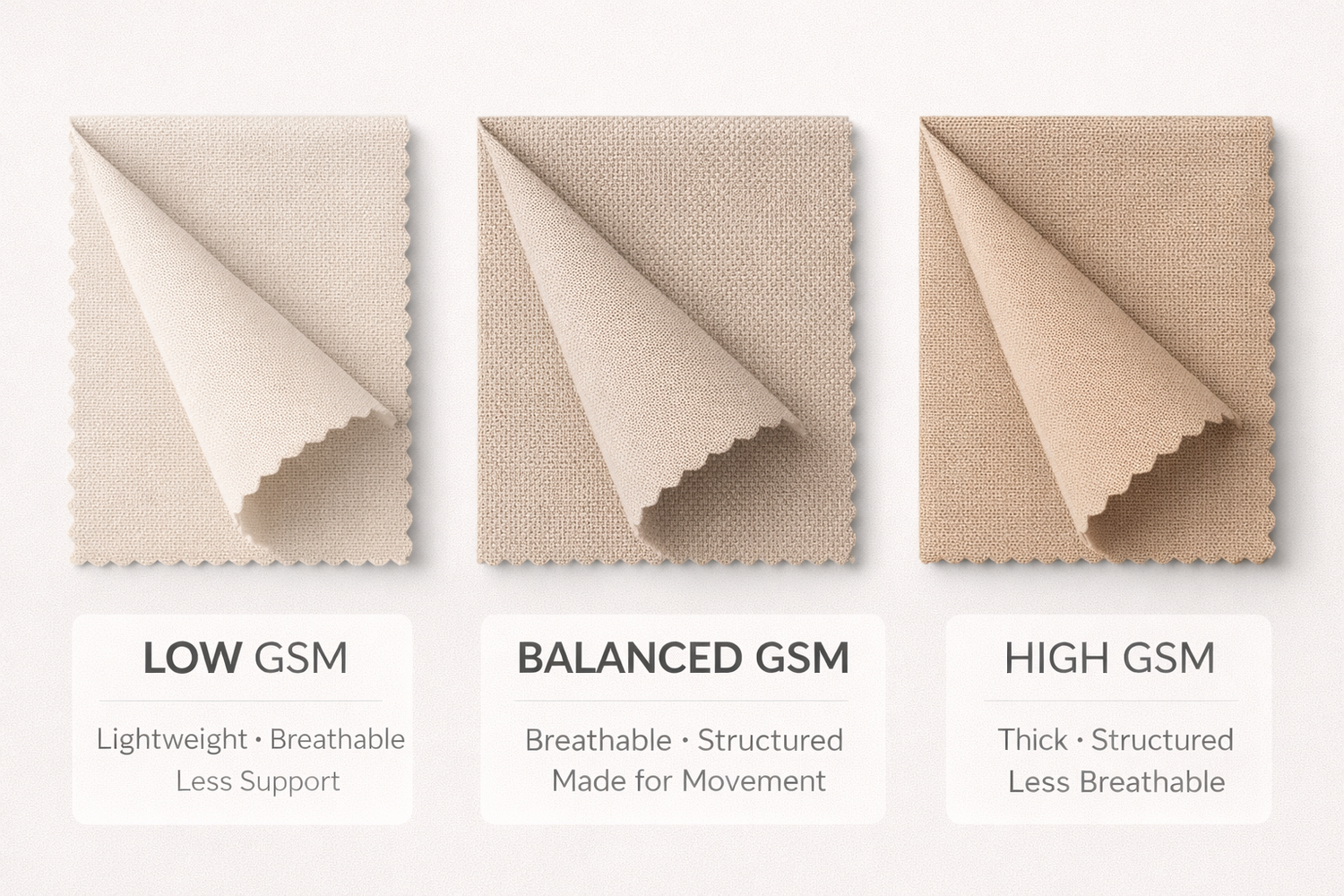
GSM stands for grams per square meter. It is a technical measurement used to indicate fabric weight.
As a general guide:
- 120–160 GSM = lightweight, airy, less structured
- 180–220 GSM = balanced performance, often ideal for leggings and versatile activewear
- 240+ GSM = heavier, more compressive, more structured
But GSM on its own is not the full story.
A high GSM fabric can feel luxurious, but it can also feel hot, heavy, and bulky if used in the wrong garment. A lighter GSM fabric can feel breathable and fluid, but if poorly constructed, it can lack support or coverage.
Higher GSM does not automatically mean better.
Lower GSM does not automatically mean poor quality.
What matters is whether the GSM suits the function of the garment.
Where Thick Fabric Works Best
Thicker fabric absolutely has a place in performance wear. The issue is not thickness itself. The issue is overusing thickness as a shortcut for quality.
1. High-Support Sports Bras
In sports bras, more structure is often necessary. Higher GSM fabrics can help provide:
- better support
- bounce control
- stability during movement
- a more secure fit during high-impact activity
This is why structured sports bras often benefit from thicker fabric zones or thicker lining. In this category, support matters more than an ultra-light feel.
2. Compression and Sculpting Panels
Thicker or more compact constructions can also work well in:
- waistbands
- tummy-control areas
- supportive contour zones
These areas need hold, not just softness.
3. Cooler Conditions or Indoor Workouts
Heavier fabrics can also feel good in controlled indoor environments, air-conditioned studios, or cooler weather.
The Hidden Problems With Overly Thick Fabric
While thicker fabrics can feel premium in hand, they often come with trade-offs—especially in Indian conditions.
- Heat retention: heavier fabrics can trap warmth and feel uncomfortable in hot weather
- Reduced breathability: airflow can suffer when fabrics are too dense
- Bulk during movement: some garments feel stiff or heavy instead of fluid
- Longer drying time: thicker fabrics may hold more moisture after sweat
- All-day discomfort: a garment that feels good for five minutes may not feel good for five hours
That is where the “thick is better” mindset starts to fail.
Where Thin Fabric Works Best
Thin fabrics are often underrated because people confuse lightness with weakness. In reality, lightweight fabrics can be highly effective when used correctly.
1. Breathability and Airflow
Lighter fabrics are often better for:
- hot climates
- humid weather
- outdoor movement
- daily wear beyond workouts
They allow the body to breathe more easily and can feel far more comfortable over long hours.
2. Ease of Movement
Thin, well-engineered fabrics can move naturally with the body. This matters when activewear is no longer worn only for a one-hour workout, but for a full day that might include training, errands, travel, and casual wear.
3. Faster Drying
Lightweight fabrics usually dry faster, which is especially useful in Indian summers and humid conditions.
Where Thin Fabric Falls Short
Thin fabric is not always the answer either. If taken too far, it can create its own problems:
- lack of support in high-impact activity
- reduced stability
- risk of transparency if poorly engineered
- less compression where support is needed
So again, the answer is not simply “thick” or “thin.”
The Best Performance Fabrics Use Balance, Not Extremes
The strongest activewear does not blindly choose one side.
It uses thickness strategically.
That means:
- more structure where support matters
- less bulk where flexibility and airflow matter
- balanced GSM where comfort and performance must coexist
This is especially important today because activewear is no longer just gym wear. It is everyday wear.
Why This Matters More in India
Fabric decisions cannot be separated from climate.
Indian consumers often move through:
- heat
- humidity
- indoor-outdoor transitions
- long commutes
- all-day wear cycles
In this setting, overly thick activewear can quickly start feeling heavy and uncomfortable. At the same time, overly thin activewear may not offer enough confidence, support, or performance.
This is why activewear for India needs smarter balance—not just a heavier handfeel.
How RYZ Approaches Fabric Thickness
At RYZ, fabric thickness is not treated as a blanket brand rule. It is decided garment by garment, based on what each piece is supposed to do.
Sports Bras: Structure Where Support Is Needed
For sports bras, support matters. That is where thicker GSM and strategic lining make sense. This helps provide stability, support, and better movement control where the garment demands it.
Leggings: Balanced Around Performance and Wearability
For leggings, RYZ takes a more balanced route. Around 200 GSM creates a sweet spot:
- not too thick to feel bulky
- not too thin to feel underpowered
- comfortable enough to move with you
- structured enough to feel reliable
This is where many brands misread the market. Some push very thick leggings because they feel substantial in hand, but in actual wear they can feel warmer, heavier, and less versatile.
A balanced legging fabric often performs better in real life than an excessively thick one.
Tops: Lightweight Where Breathability Matters
For tops, lighter fabric often makes more sense. Breathability, airflow, and ease of layering become more important than thickness for its own sake.
That is why a performance-led brand should not use one fabric philosophy across every category.
Where thick is needed, use thick.
Where lightness is needed, use lightness.
Activewear Has Changed—And Fabric Expectations Have Changed Too
There was a time when activewear was designed mainly for the workout itself.
Now, activewear is expected to move through the whole day:
- gym
- coffee
- errands
- travel
- casual styling
As activewear becomes more integrated into everyday dressing, fabric has to do more than just compress. It has to balance:
- comfort
- support
- breathability
- shape retention
- all-day wearability
This is exactly why “thicker automatically means better” is no longer a useful standard.
So What Should You Actually Look For?
When evaluating activewear, ask these questions instead:
- What is the garment meant to do?
- Is the GSM appropriate for that use?
- Will this fabric breathe well in my climate?
- Does it feel supportive without feeling bulky?
- Will it move with me across the day?
Those questions will tell you far more than thickness alone.
Explore RYZ Activewear
If you are looking for premium activewear engineered with balance in mind, explore:
Final Takeaway
Thicker fabric can feel better in hand. But better handfeel does not automatically mean better performance.
Too thick, and a garment can become hot, bulky, and less wearable.
Too thin, and it may lose support and confidence.
The best activewear is not about thick versus thin.
It is about using the right fabric weight in the right garment for the right climate.
That is where true performance starts.
FAQs
Is thicker fabric better for gym wear?
No. Thicker fabric can offer support and structure, but it can also reduce breathability and trap heat. The best gym wear uses the right thickness for the specific garment.
What is the best GSM for leggings?
For many leggings, around 180–220 GSM offers a strong balance of comfort, movement, opacity, and support. Around 200 GSM is often a practical sweet spot.
Are thin activewear fabrics bad?
No. Thin fabrics can be excellent for breathability, comfort, and all-day wear. They only become a problem when the garment needs more support than the construction can provide.
Why do very thick leggings sometimes feel uncomfortable?
Very thick leggings can feel warm, bulky, and less breathable—especially in India’s climate. They may feel premium at first touch but less comfortable during longer wear.
Does thicker fabric make leggings more squat-proof?
Not automatically. Squat-proof performance depends on fabric density, stretch recovery, and construction—not just thickness alone.
Why are sports bras often made with thicker fabric?
Sports bras often need more support, stability, and bounce control. That is why thicker fabric or thicker lining can make sense in this category.
What kind of activewear fabric works best in Indian weather?
Breathable, moisture-managing, balanced-weight fabrics generally work best in Indian conditions, especially for garments meant to be worn beyond the gym.
Is lightweight activewear less premium?
No. Lightweight activewear can be highly premium if it is well engineered. Quality comes from performance, recovery, construction, and suitability—not just handfeel.


Leave a comment
This site is protected by hCaptcha and the hCaptcha Privacy Policy and Terms of Service apply.